
Search by Keywords | Ink Cartridge Model
The above brand names are trademarks of their respective owners.
All brand names displayed on this page are used only to show the compatibility of the respective products.
We use cookies to personalize content and ads, provide social media features, and analyze our traffic. By clicking Privacy Policy.
Please contact us for more information
Share this article to your friends
Highlights
High-speed TIJ barcode coding on logistics carton lines means printing barcodes directly onto cartons while they move along a conveyor, using thermal inkjet (TIJ) printheads. The printed content is usually an ITF-14 or GS1-128 barcode plus shipping information. This approach can replace pre-printed outer cases and reduce labeling work, so one blank carton can serve different products and shipping batches.
Logistics barcodes are read by machines, not people. Sortation systems, warehouse scanners and receiving-end readers all expect consistent barcode size, quiet zones and print quality. As a result, barcodes leave much less room for error than the batch codes printed in manufacturing. For how this fits among other TIJ applications, see Complete TIJ Printing Applications for Manufacturing, Logistics, E-Commerce and Specialty Industries.
Three Requirements for Barcode Printing on Logistics Cartons
Barcode printing on a conveyor line can be evaluated against three requirements:
Higher resolution helps bar-width accuracy but lowers the maximum line speed. Switching to an ink with stronger adhesion also changes drying and absorption behavior. Equipment selection should therefore balance barcode quality, data accuracy and line speed rather than optimize a single metric.
Corrugated Ink Absorption and TIJ Ink Selection
Corrugated board is a porous substrate. Ink drops penetrate and spread along the paper fibers, so the edge of every printed bar grows outward slightly. Bars get wider, spaces get narrower, and the wide-to-narrow ratio the scanner measures shifts. Barcodes are generally more sensitive to this edge spread than ordinary date or batch codes.
Kraft Corrugated vs. White Coated Cartons
Two carton surfaces are common in logistics:
From Uniplus's experience running print trials on customers' carton samples, barcode quality can change when the same brand's outer case switches paper mill or surface treatment. Run trials on production cartons, not prototype cartons, and check again whenever the carton supplier changes.
Water-Based vs. Solvent-Based Inks on Cartons
Uncoated corrugated cartons are usually suited to water-based TIJ inks. Decap time is how long a printhead can sit exposed to air and still fire normally. Optical density, water resistance, rub resistance and decap time all vary by formulation, for dye and pigment inks alike. The dye/pigment category alone does not determine them.
If cartons will face humidity, handling abrasion or long-term storage, select by the test results of a specific ink model for water resistance, rub resistance and decap time.
Varnished, laminated or plastic-wrapped cartons behave close to non-porous substrates, so solvent-based inks designed for non-porous materials are usually used instead. Solvent formulations also differ widely. Whether one model works on both porous and non-porous surfaces depends on its specifications and trial results. See the Uniplus industrial cartridge product page for the substrates each model suits.
GS1 Size and Quality Rules for ITF-14 and GS1-128
GS1 barcode specifications start with the right Symbol Specification Table. These are the GS1 tables that set size and quality requirements for each application and scanning environment. Trade items (outer cases) and logistic units carrying an SSCC are identified differently, so their size ranges are not always the same.
The two most common barcodes on logistics cartons serve different purposes:
Identical trade item groupings share the same GTIN. When the packaging level or contents change (for example, a case of 12 bottles becomes a case of 24), GS1 GTIN allocation rules decide whether a new GTIN is needed.
The rules below follow the GS1 General Specifications (Release 26.0). For trade items scanned in general distribution, ITF-14 and GS1-128 use a module width (X-dimension, the width of the narrowest bar) of 0.495 to 1.016 mm. Quiet zones must be at least 10 times the X-dimension on each side, and the standard bar height is 31.75 mm.
For a GS1-128 barcode carrying an SSCC on a logistic unit, the maximum X-dimension is 0.940 mm. GS1 sets this lower ceiling because of the maximum symbol length allowed for GS1-128.
A common nominal ITF-14 configuration uses X = 1.016 mm, the upper end of the permitted range. At this size, each quiet zone is about 10.2 mm and total width including quiet zones is about 142.75 mm. Actual width also depends on the wide-to-narrow ratio (how much wider the wide bars are than the narrow ones) and the bearer bar design. Confirm the carton face is wide enough before printing.
Calculate Bar Height and Total Symbol Height Separately
GS1 bar height counts the bars only. It excludes the human-readable digits below and the ITF-14 bearer bars, which are the thick frame lines around the symbol. When planning the print area, add bar height, bearer bars and human-readable text separately to get the total height needed on the carton face.
Bar height may be reduced only when the physical item is too small for 31.75 mm, using the rules in the table above. For logistic units, the 15% rule often sets the floor: an SSCC barcode 110 mm wide including quiet zones needs at least 16.5 mm of bar height, not 12.70 mm.
Reduction is based on the physical space on the item or logistic unit, not on the printing equipment. A printhead that only reaches 12.7 mm is not a reason to shorten the bars.
Minimum Print Quality Grades
GS1 states minimum quality as grade/measuring aperture/light wavelength. The measuring aperture is the size of the verifier's effective measurement spot, in thousandths of an inch. The required values depend on the application table. For general distribution, GS1-128 requires 1.5/10/660. ITF-14 printed directly on corrugated board with an X-dimension of 0.635 mm or more may use 0.5/20/660. Below 0.635 mm, the stricter requirement applies again.
GS1 explains the corrugated exception through Symbol Contrast, the reflectance difference between dark bars and light spaces. Corrugated board usually has lower background reflectance, which can limit Symbol Contrast, so these applications use a different aperture and minimum grade. GS1 UK's ITF-14 sizing guide gives a concise summary of X-dimension and print substrate.
What 31.75 mm Bar Height Means for Printhead Setup
A single HP TIJ 2.5 printhead prints 12.7 mm high, so one printhead cannot reach the 31.75 mm standard bar height. Two approaches are common:
With either approach, the seams between printheads must be aligned, or bars will show offsets or white lines at the joins. For the practical differences between the two formats, see 12.7 mm vs. 25.4 mm industrial cartridges.
How Do Line Speed and Resolution Affect TIJ Barcode Readability?
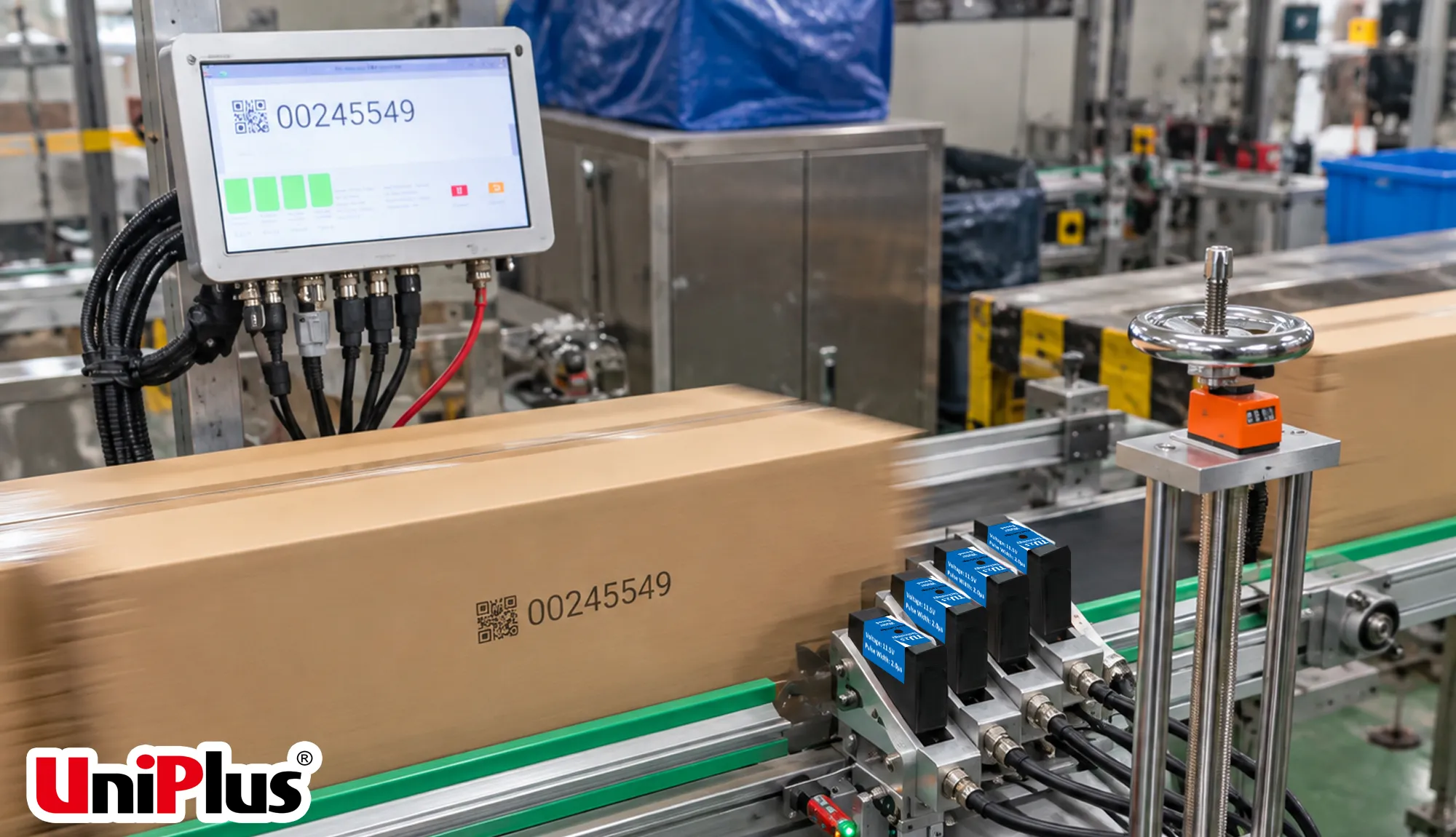
Firing frequency is how many times per second each nozzle can fire a drop. At a fixed firing frequency, the faster the line, the lower the horizontal resolution the printhead can deliver. Bar-width accuracy then depends on horizontal resolution and how well firing stays synchronized with line speed.
Logistics barcodes are usually printed in picket fence orientation, with bars perpendicular to the direction of travel. Bar height comes from the printhead's print height. Bar width is built up dot by dot along the direction of travel, according to firing timing.
Published figures show the size of this tradeoff. In HSA Systems' HP TIJ 2.5 printhead specifications, one configuration at 600 dpi vertical lists a maximum of 38 m/min at 600 dpi horizontal and 76 m/min at 300 dpi horizontal. These figures describe that supplier's specific configuration, not a general TIJ 2.5 limit. Maximum speed also depends on the printhead, printhead and controller configuration and the ink, so check the equipment supplier's current specifications.
Three further factors affect bar-width accuracy:
Higher resolution is not always better. It lowers the maximum line speed, while ink laydown and spread depend on drop size and print mode rather than dpi alone. Whether a barcode meets the required quality grade should be checked with a barcode verifier using the ISO/IEC 15416:2025 measurement method, not by eye, and not by "the scanner can read it."
TIJ Printhead Setup on High-Speed Conveyors
Once barcode specifications and resolution are set, three mechanical factors decide whether the line prints reliably: throw distance and carton guiding, print triggering, and dust control.
Throw Distance and Carton Guiding
TIJ throw distance (the distance from nozzle to print surface) is short, and the usable range varies with printhead, ink and line speed. For HSA Systems' HP TIJ 2.5 systems, published specifications for different printhead series range from about 0.5–2.0 mm to 0.5–5.0 mm. Follow the specifications of the printhead and ink actually used.
If a carton bulges, has raised flaps or runs skewed on the conveyor, throw distance changes within a single barcode and bar edges blur. The usual fix is to add guide rails or side-pressure mechanisms before the print position, so the carton face sits against the same reference plane. In Uniplus's on-site evaluations, the most common problems come from this kind of mechanism rather than the ink. Ink selection alone cannot compensate for unstable carton positioning.
Triggering and Speed Synchronization
Printing usually starts when a photoelectric sensor detects the carton's leading edge. Place the sensor away from flaps and tape, or it will trigger falsely and the barcode position will drift. If conveyor speed is not constant, use an encoder to feed actual conveyor speed back to the controller, so bar widths stay consistent as speed changes.
Dust and Printhead Maintenance
Corrugated cartons shed paper dust during conveying and friction. Once dust settles on the nozzle plate, it can affect ink ejection and print quality. Set a nozzle-plate wiping frequency based on the dust level on site.
On lines with irregular carton spacing, the printhead sits idle in intervals. An ink formulation with longer decap time, combined with periodic nozzle firing ("spitting") settings on the controller, can reduce missing lines when printing resumes.
SSCC Variable Data Integration and Read Verification
ITF-14 usually carries the GTIN of an outer-case grouping, which is the same on every identical case. It does not give each carton a unique serial number. When each logistic unit needs a unique identifier, logistics processes usually use an SSCC (Serial Shipping Container Code), printed as a GS1-128 barcode.
The SSCC is a unique 18-digit number that stays the same throughout the logistic unit's life. The printed content therefore changes for every logistic unit.
Data Flow From WMS to Printhead
For per-carton variable data, the main integration challenge is data flow rather than ink selection. A typical flow:
Readers vs. Verifiers
An inline reader can only confirm whether a barcode decodes and whether the data is correct. It cannot replace quality grading. A verifier measures barcode quality grades according to the ISO/IEC 15416 method.
Verification is usually done by sampling at installation and whenever cartons or ink change. During production, read-rate monitoring tracks ongoing performance.
When switching from labels to direct printing, choose the matching Symbol Specification Table in the GS1 General Specifications. The choice depends on barcode purpose, scanning environment, substrate and print method. For example, ITF-14 printed directly on corrugated board has its own X-dimension condition and minimum quality requirement.
On-Site Evaluation Checklist Before Installation
To evaluate barcode printing on logistics cartons, prepare the following information first:
Other logistics scenarios, such as cold chain delivery, variable e-commerce order numbers and export pallets, have their own evaluation priorities; see the TIJ printing applications guide.
Uniplus TIJ Cartridges for Logistics Cartons
At Uniplus, we have focused on manufacturing thermal inkjet cartridges since 2002. Our industrial cartridges cover three ink types: solvent-based, water-based dye and water-based pigment.
We offer two cartridge formats. The half-inch (12.7 mm) format matches the TIJ 2.5 print height. The one-inch (25.4 mm) format requires equipment that supports it. For specifications, compatible models and available colors, see the latest information on our industrial cartridge product page.
We also offer compatibility verification. If your equipment uses encrypted chips, provide the machine model during compatibility evaluation and we will help assess workable options.
We recommend running a print trial before deciding. To start, send us:
With these, we can narrow down the ink type and printhead setup, then confirm them with actual print trials. Use our contact form to discuss your line conditions with us.