
Search by Keywords | Ink Cartridge Model
The above brand names are trademarks of their respective owners.
All brand names displayed on this page are used only to show the compatibility of the respective products.
We use cookies to personalize content and ads, provide social media features, and analyze our traffic. By clicking Privacy Policy.
Please contact us for more information
Share this article to your friends
TIJ Coding on Glass, Acrylic and Metal Tube Packaging for Cosmetic BrandsTIJ coding for cosmetic packaging means using thermal inkjet (TIJ) cartridges to print batch numbers, manufacturing dates and expiry information directly onto glass bottles, acrylic jars and metal tubes. These surfaces generally lack the ink absorption of paper, so print quality depends on how the ink wets, adheres to and forms a film on the surface. Bottles and tubes are also often curved, which means the distance between the printhead and the package can change across the print area. Cosmetic brands hold packaging appearance to a far higher standard than most industrial goods, and a single smudged character can be enough for quality control to reject an entire batch.
If you are comparing coding approaches across industries, start with the overview in Complete TIJ Printing Applications for Manufacturing, Logistics, E-Commerce and Specialty Industries, then come back to the details of cosmetic packaging.
Highlights
Batch Number and Expiry Labelling Requirements for Cosmetics
Most of what a cosmetic brand codes on its packaging is set by regulation, not by the brand. Under Article 7 of Taiwan’s Cosmetic Hygiene and Safety Act, the outer packaging or container of a cosmetic product must clearly show the batch number and one of three date combinations:
Where the outer packaging or container is too small to carry this information, the same article allows it to be provided on a label, a package insert or by other means.
Products exported to the EU follow a different set of rules. Article 19 of Regulation (EC) No 1223/2009 on cosmetic products requires the batch number of manufacture or a reference that identifies the product; where the product is too small for this to appear on the container, it may appear on the packaging only. For dates, products with a minimum durability of 30 months or less must show a date of minimum durability. Products with a minimum durability above 30 months generally show a period after opening (PAO) instead, although PAO may be omitted where the concept of durability after opening is not relevant, which must be confirmed against the product’s characteristics and safety assessment.
Batch numbers, manufacturing dates and expiry dates may change with each production batch or schedule, so the line needs a way to update this information flexibly. Common options include pre-printed packaging, applied labels, laser marking and direct coding. For cosmetic brands that change batch data frequently and want to avoid adding a label, direct TIJ coding is an option worth evaluating. Whichever method is used, the finished product still needs to be checked against the labelling content and placement rules of each target market.
Surface Properties of Glass, Acrylic and Metal Tubes
Corrugated cartons draw ink into their fibres. Glass, acrylic and metal tubes generally do not absorb it. Whether the ink stays on the surface depends on several factors: how well the ink wets the surface, the adhesion between ink and surface, how the ink dries or forms a film, and whether any surface coating is compatible with the ink formulation. Each of these materials presents different surface challenges, so compatibility needs to be tested on the actual containers rather than judged by the material name alone.
Glass Bottles: Surface Cleanliness and Cold-End Coatings
Clean glass has high surface energy, which helps the ink wet the surface, but that does not guarantee adequate adhesion, water resistance or rub resistance once the ink has dried. On real production lines, problems often come from something other than the glass itself. Some glass containers leave the factory with a cold-end coating that reduces scratching between bottles. On sandblasted, frosted or spray-coated cosmetic bottles, the ink is actually landing on the coating. Bottles brought to the line from cold storage may already carry a film of condensation.
Adhesion can change when the same bottle design comes from a different glass supplier or coating batch, so it is worth requesting surface treatment data from the bottle supplier before introduction. There are more bottle factors to consider when choosing a cartridge, and they will be covered in a dedicated article, “How to Choose Thermal Inkjet Cartridges for Glass Printing.”
Acrylic: Crazing Caused by Solvents and Stress
Some double-wall cream jars and foundation bottle shells are made of acrylic (PMMA). Acrylic is highly transparent, so any printing defect is plainly visible, and solvents bring a further risk. A study on PMMA found that, under its experimental conditions, alcohol treatment combined with stress concentration from machining lowered the stress threshold at which PMMA begins to craze.
The study used specific PMMA specimens and treatment conditions that differ from the brief contact of ink droplets on a bottle, so it cannot be taken to mean that every solvent-based ink will cause crazing. It does show that the risk is worth testing before introduction. Injection-moulded jars may carry residual stress, to a degree that depends on the mould, processing and annealing conditions; solvent-based ink and the alcohol wipes commonly used on production lines are both factors to evaluate. Some containers labelled “acrylic” are actually PETG, SAN or another transparent plastic, so confirm the material with the container supplier first, and pay attention to stress-concentrated areas such as the neck and edges during testing.
Metal Tubes: Ink Adheres to the Coating, Not the Metal
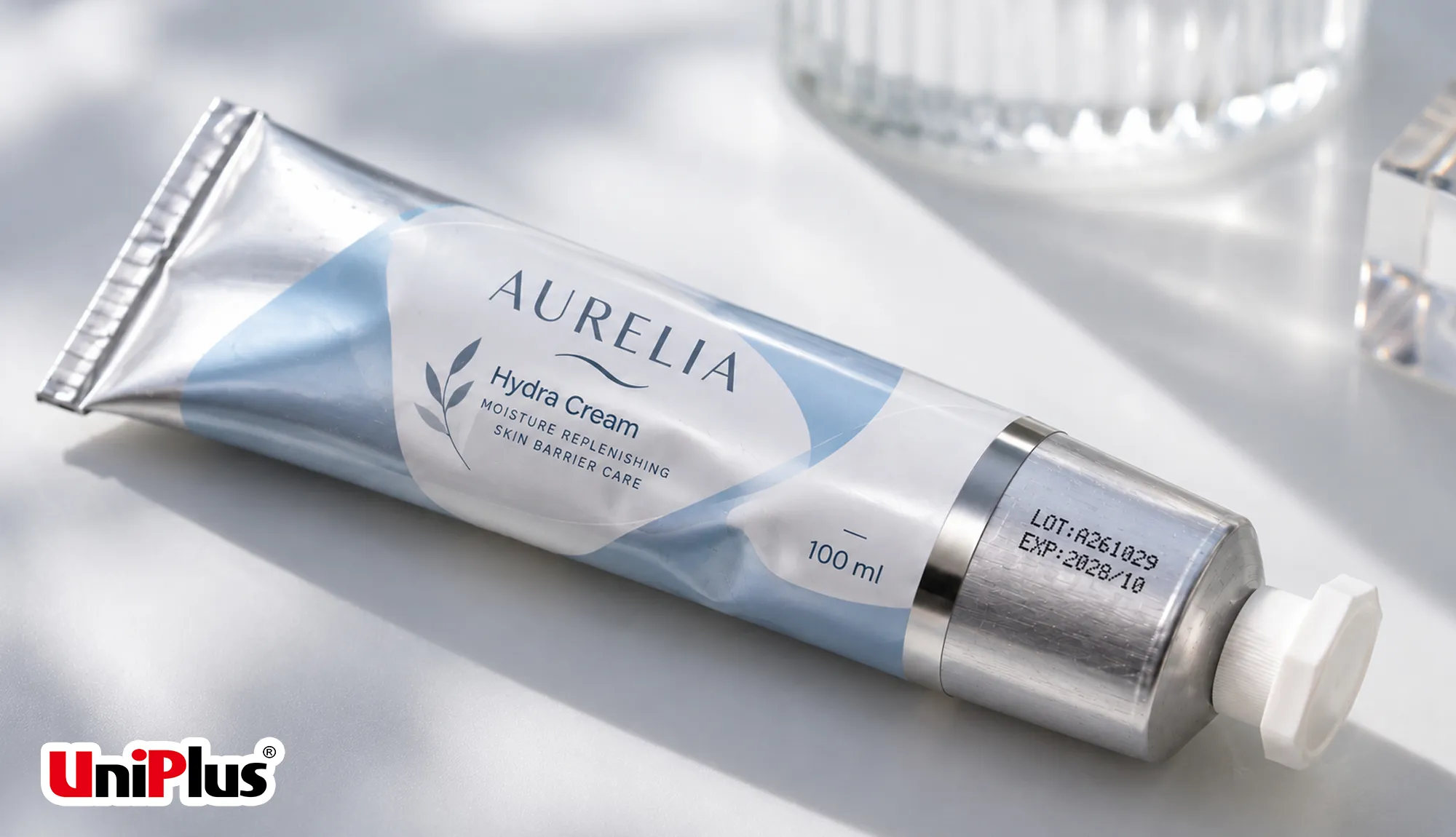
Coated aluminium tubes, widely used for hand creams, eye creams and hair colourants, usually carry a base coat, a printed layer and a gloss varnish on the outside. The coding ink contacts the outermost varnish, so adhesion depends on that coating rather than on the aluminium. A change of tube supplier or a switch to matte varnish calls for retesting, and bare or anodised aluminium needs to be evaluated separately.
The outer layer of laminate tubes is commonly PE or another polymer, and the actual structure should be confirmed against the tube supplier’s specifications. When the outer layer is PE, adhesion behaves more like a plastic bottle, and the surface treatment practices in High-Adhesion TIJ Coding on PE/PP Bottles for Personal Care Brands apply. Tubes are commonly coded on the flat crimped seal formed after filling. This area is unaffected by curvature but has limited width, so character height must be designed around the size of the seal.
TIJ Throw Distance and Fixture Positioning on Curved Bottles
When cylindrical cosmetic containers are side-coded, bottle curvature can change the distance between the printhead and the surface being printed. The actual distance variation and drop placement depend on bottle diameter, printhead orientation, whether the container moves in a straight line or rotates, and how the printed content is arranged.
Take the most common setup: an upright bottle travelling in a straight line on a conveyor past a fixed side-mounted printhead, with the text formed along the direction of travel. The distance is shortest when the bottle’s centre is directly in front of the printhead. As the centre moves away, the bottle surface directly in front of the printhead recedes, and characters fired at that moment travel further. TIJ is a short-throw technology: once the gap between printhead and surface exceeds an appropriate range, the risk of drop placement error and reduced print quality increases. In this setup, the middle of the text may print more sharply than the ends, but actual results must be tested with the specific printhead, ink and line conditions. The permissible throw distance is set by the equipment and cartridge specifications.
The table below is a cylindrical cross-section estimate. Taking the position where the bottle’s centre faces the printhead as the reference, it assumes the centre moves half the print span to each side during printing and ignores drop flight time and trigger compensation. It calculates how far the surface directly in front of the printhead recedes from the closest point at each end of the span. Print span here means the distance the bottle’s centre travels during printing, which is not necessarily the same as the final text width on the curved surface.
This model is useful for a first understanding of how curvature affects throw distance, but it excludes the initial printhead gap, bottle wobble, print trigger timing, drop flight time and landing on an inclined surface. It cannot be used to determine the permissible throw distance or print quality of production equipment. In geometric terms, when the print span is small relative to the bottle diameter, halving the diameter roughly doubles the distance difference; as the span approaches the diameter, the difference grows faster. For example, a batch-and-expiry line with a 15 mm print span on a 30 mm serum bottle shows a distance difference of about 2 mm between the ends and the middle.
In our experience helping customers evaluate curved-surface coding, problems usually start with printhead angle and fixture positioning rather than with the ink. Four common ways to improve results, each of which should be confirmed against the actual printhead orientation and conveying method:
Shoulders, tapered bottles and irregular shapes produce more complex distance changes, so print on the straight section of the bottle wherever possible. The principles and measurement of throw distance will be covered in a separate article.
Covert Traceability With Invisible Ink and Matching Light Sources
Cosmetic brands have very little tolerance for visual intrusion, and some information is better kept out of consumers’ sight, such as distribution channel codes, distributor regions or anti-diversion numbers. Invisible ink suits this kind of covert traceability: it is hard to see under normal lighting and can be read under the corresponding light source when needed.
Invisible ink cannot replace mandatory labelling. Taiwan requires the batch number to be clearly shown, and the EU requires labelling to be legible, so mandatory information must still be displayed in a readable form that meets the target market’s rules. Invisible codes are an additional traceability layer.
For fluorescent invisible ink, obtain the excitation wavelength for the specific ink model from the supplier before introduction; this is the wavelength of light that makes the ink visible. The inspection light on site must match it. When the wavelength is off, the ink appears noticeably weaker or may not be readable at all. For invisible inks based on other principles, confirm the inspection method with the supplier. Two points are often overlooked:
Invisible ink models and options change as the product line is updated; see the industrial cartridge product page for current information.
Adhesion and Appearance Testing Before Introducing TIJ on Cosmetic Lines
Codes on cosmetic containers have to survive filling, cartoning, shipping, shelf display and daily handling by consumers. A clean result in the lab does not mean the same result on the line. Uniplus recommends testing on actual production containers, with the same coating batch and bottles from the same supplier, rather than on clean sample bottles.
Common tests:
From a cartridge supplier’s standpoint, the most helpful thing is to receive production container samples, line speed and print content early in the evaluation. When the container batch or coating changes, testing has to be repeated, and that is hard to fix after the fact.
Coding on Folding Cartons and Shipping Cases
Batch and date information on cosmetic products usually appears on more than the bottle; folding cartons and shipping cases often need matching codes. Some cosmetic cartons use varnished, UV-coated or laminated board with low absorbency, which behaves very differently from ordinary corrugated board. Shipping cases are mostly corrugated and can take a range of inks suited to absorbent substrates, though bleed and barcode quality still need to be checked.
On the same line, bottles, cartons and cases often need different ink types. The adhesion differences between coated and glossy paper will be covered in “TIJ Printing on Coated and Glossy Paper: Ink Adhesion Characteristics.” For case coding in logistics and practices in other industries, refer back to Complete TIJ Printing Applications.
Which TIJ Cartridge Suits Cosmetic Packaging?
For non-porous packaging such as glass bottles, acrylic jars and coated metal tubes, solvent-based TIJ cartridges are usually the first option to evaluate, especially on lines that need fast drying and rub resistance. Actual suitability still depends on ink formulation, surface coating, drying conditions and adhesion test results. Water-based dye and pigment inks are commonly used on absorbent materials such as corrugated cases, and some specialised water-based formulations can be used on treated non-porous surfaces. Selection should be based on the substrate and the performance actually required, not on the water-based or solvent-based label alone.
In terms of format, a half-inch (12.7 mm) cartridge can arrange single or multiple lines within its print height. Consider the one-inch (25.4 mm) format only when the total print height of batch number, dates and other information exceeds the half-inch range. The printable area on cosmetic containers is usually small, so character height should first be set by the straight section of the bottle or the size of the tube seal.
Uniplus offers compatibility verification services. You can share the machine model during discussions, and we will help assess feasible options. For ink colours and models, see the industrial cartridge product page.
If you are evaluating coding for a new bottle design or production line, contact us with container samples and line conditions, and we can work out a suitable cartridge and test plan together.