Search by Keywords | Ink Cartridge Model

We use cookies to personalize content and ads, provide social media features, and analyze our traffic. By clicking Privacy Policy.
Please contact us for more information
We use cookies to personalize content and ads, provide social media features, and analyze our traffic. By clicking Privacy Policy.
Please contact us for more information
Share this article to your friends
TIJ Thermal Inkjet Technology: A Complete Guide to Application Scenarios
Highlights
What is TIJ thermal inkjet technology? Simply put, it is a marking technology that uses a heated printhead to precisely jet ink droplets onto the surface of various substrates. For an in-depth look at the operating principles and ink cartridge structure, please refer to "What Is TIJ Thermal Inkjet Printing? A Complete Beginner's Guide".
Regulatory Trends: Why Inkjet Marking Has Become an Industry Standard
Inkjet marking is no longer simply a "convenient management" option — it is a hard regulatory requirement. The EU Packaging and Packaging Waste Regulation, which took effect in 2025, explicitly requires packaging to carry a QR code or other standardized digital data carrier for traceability and recycling disclosure. This means virtually all packaging sold into the EU must bear a machine-readable inkjet mark.
Grand View Research also reports that TIJ thermal inkjet is the fastest-growing technology segment in the inkjet coding and marking equipment market, driven primarily by increasingly stringent labeling and traceability regulations across the food, pharmaceutical, and electronics industries. For inkjet coding and marking equipment manufacturers and brand owners, the supply stability and specification compatibility of TIJ ink cartridges will directly determine whether their products can meet export market compliance requirements.
To learn more, see: How Coding Equipment Adds Value to Manufacturing Production Lines: 5 Application Scenarios and Implementation Guide.
In Uniplus's experience working with manufacturers across more than twenty years, regulatory changes tend to arrive earlier than companies expect. Many of our customers began evaluating inkjet coding equipment only after export buyers required QR code marking on outbound shipments. The modular, quick-change nature of TIJ ink cartridges allows production lines to meet new compliance requirements with minimal downtime risk.
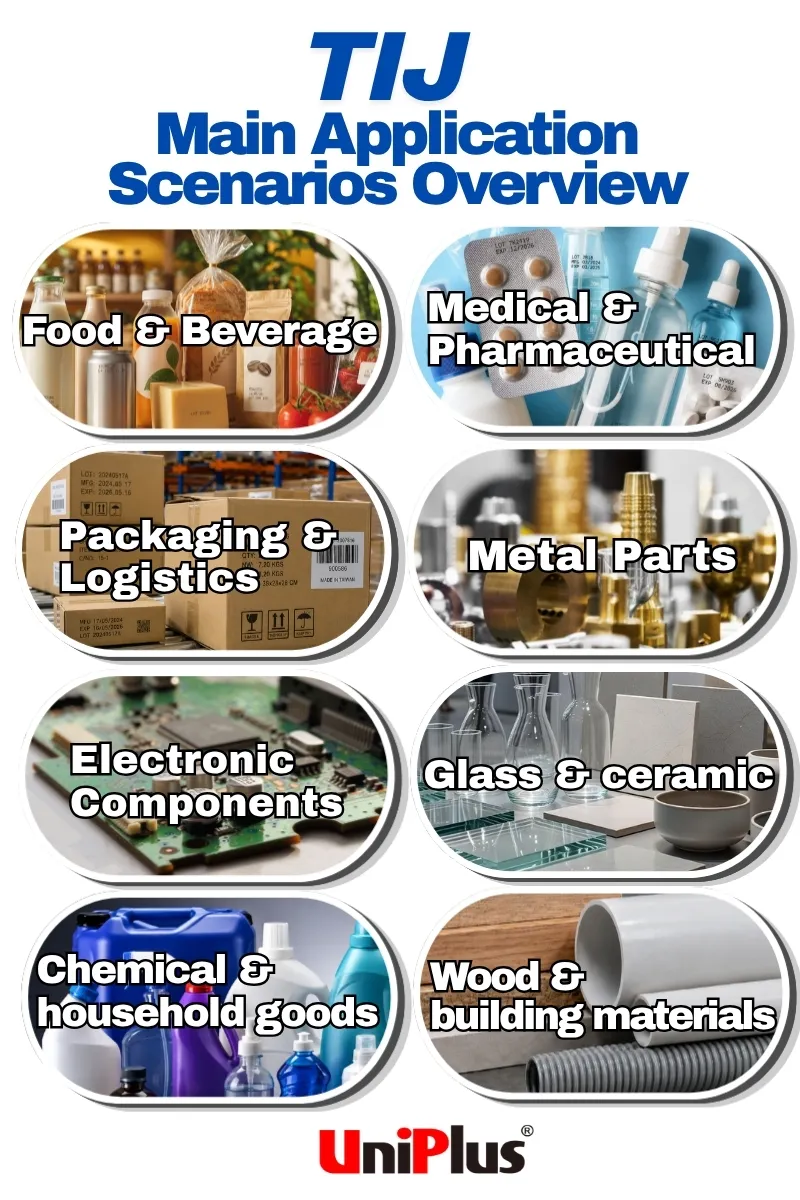
Food & Beverage: Paper Packaging, Foil Packaging, and Aluminum Can Marking
The food industry demands fast drying, non-contaminating, and food-contact-safe marking. For paper packaging such as cartons and folding boxes, ink must penetrate porous surfaces quickly and dry before adjacent packages are soiled on high-speed production lines. Date codes on Tetra Pak and foil packaging must adhere firmly without smearing during refrigeration or transportation; and batch number printing on beverage aluminum cans presents similar challenges with curved and metallic surfaces.
Research published in Food Packaging and Shelf Life notes that inkjet printing on food packaging is increasingly extending into sensing and information marking applications, raising the bar for ink stability and printability. Food-grade water-based dye or solvent-based ink cartridges are recommended to achieve both vivid color and fast-drying performance.
In food applications, the question Uniplus receives most often is: "Beyond eggs, what other substrates can TIJ print on?" The answer: with the right solvent-based or water-based formulation, aluminum foil pouches, Tetra Pak cartons, and beverage cans all achieve consistent print performance. Food safety compliance is the baseline for our ink formulation development. The selection logic differs between food-contact and non-contact surfaces — we recommend confirming the application scenario before specifying an ink type.
Packaging & Logistics: Carton Batch Numbers, Barcodes, and QR Codes
The most common requirements in packaging and logistics are batch number, barcode, and QR code printing on outer cartons for warehouse traceability management. Corrugated cardboard is a porous substrate, making it well-suited to both water-based dye and pigment ink cartridges, which absorb quickly and dry fast.
Research in the MDPI Journal of Imaging confirms that print resolution and module size are critical factors in QR code readability — reinforcing the importance of 600 DPI resolution in industrial inkjet printing. Insufficient resolution leads to scan failures that disrupt shipping operations.
Uniplus water-based pigment ink cartridges have been validated across a large number of carton barcode production lines. In practice, we find that long decap time is especially critical for intermittent lines — manual loading stations, line stoppages, and shift changeovers all create periods where the printhead sits uncapped. Maintaining scan pass rates depends on the ink not drying in the nozzles during those gaps.
Medical & Pharmaceutical: Blister Foil Marking
Medical and pharmaceutical packaging carries the most stringent marking requirements. Batch codes on drug blister packs (Blister Foil) must remain legible and resistant to fading. MDPI research highlights that substrate characterization of pharmaceutical blister packaging is essential to quality assessment. Since blister materials are typically aluminum-plastic composites, solvent-based ink cartridges with strong adhesion are recommended to ensure marks remain clear after long-term storage and comply with traceability regulations.
Medical and pharmaceutical applications represent one of the areas where Uniplus has invested most heavily in ink formulation development. Blister foil printing demands not only immediate adhesion, but long-term legibility after storage. Our solvent-based formulations have undergone multiple rounds of adhesion and abrasion testing on aluminum-plastic composite substrates. Customers with anti-counterfeiting requirements can inquire about our invisible ink options.
Metal Parts Manufacturing: Serial Number Coding
Metal parts are non-porous substrates that require solvent-based ink cartridges to form a stable bond on the surface. Serial number coding is used for production traceability. Given the demanding conditions of manufacturing environments, ink cartridges with a long decap time design effectively reduce printhead clogging and maintain consistent print quality during continuous operation.
The most common implementation issue Uniplus sees in metal serial number coding is: "The ink adheres initially, but doesn't hold up to handling." The root cause is almost always the ink formulation — not the equipment — being unoptimized for the specific metal alloy and surface treatment in use. We recommend substrate sample testing before procurement to confirm adhesion performance before production deployment.
Electronic Components: PCB Batch Numbers and Part Serial Numbers
Electronics production lines demand exceptional marking precision. PCB batch numbers, component serial numbers, and anti-counterfeiting marks must remain clearly legible within confined areas. TIJ technology maintains small-character readability even at 600 DPI resolution, and paired with solvent-based ink cartridges, it delivers both scratch resistance and low odor — important considerations for indoor production environments.
In electronics production environments, odor sensitivity is often higher than on general factory floors. Low-odor ink is a practical requirement for enclosed indoor lines, not just a preference. Uniplus solvent-based formulations are designed to balance fast drying with low volatility, while 600 DPI resolution ensures small-character serial numbers remain reliably readable through automated optical inspection (AOI) workflows.
Other Common Application Scenarios
Beyond the primary segments above, TIJ thermal inkjet printing is also widely used across the following industries:
Glass & Ceramic Containers
Batch numbers and expiration dates on bottles and jars. These are typically non-porous substrates, making solvent-based ink the appropriate choice.
Textiles & Non-Woven Fabrics
Label printing and non-woven bag marking. These are porous substrates compatible with both water-based and solvent-based inks.
Wood & Building Materials
Panel specifications and batch number marking. Porous substrates work well with water-based pigment or solvent-based inks, balancing scratch resistance and low odor.
Chemical & Household Product Containers
Batch numbers and expiration dates on cleaner and cosmetic bottles. Ink selection should be based on the adhesion characteristics of the specific bottle substrate.
Automotive Parts
Part serial numbers and anti-counterfeiting traceability marks, commonly applied to metal and plastic composite surfaces.
Agricultural Packaging
Batch numbers and expiration dates on seed bags and pesticide packaging. Marks must maintain weather resistance in outdoor and humid conditions; solvent-based inks are recommended.
New Energy Products
Serial number traceability marking on solar panels and lithium battery packaging — critical for product safety recalls and quality control.
Ticket Printing
Anti-counterfeiting serial number printing on high-security documents such as tickets. Invisible inks can be added to enhance the level of security.
Application Scenario Ink Cartridge Selection Guide
Recommended ink types vary by application. The table below provides a quick reference:
For complete ink type and specification recommendations by application, please visit the Uniplus TIJ 2.5 Industrial Ink Cartridge product page.
Find the Right Ink Cartridge Specifications for Your Production Line
Recommended ink types vary by industry and substrate. Uniplus provides comprehensive TIJ 2.5 ink cartridge specification guidance — helping you identify the most suitable inkjet printing solution for your production line.
Contact Us