How do you choose between TIJ, CIJ, laser, thermal transfer, and print-and-apply labeling for your production line? A full comparison of substrates, line speed and maintenance to help procurement and plant engineers build a decision framework.
TIJ vs Other Coding Technologies: How Do You Choose the Right Fit for Your Production Line?
Choosing the wrong marking technology rarely shows up only in the equipment invoice. The real cost usually follows later, in consumables, maintenance labor, scrapped product, and line downtime.
TIJ (Thermal Inkjet) is one of the most common industrial coding technologies, but it isn't the right fit for every line. Selection shouldn't come down to resolution or unit price alone — substrate, line speed, mark durability, maintenance capacity, and total cost of ownership all need to be weighed together.
This article compares TIJ, CIJ, laser marking, thermal transfer overprinting (TTO), and print-and-apply labeling within a single evaluation framework, to help you judge which technology actually fits your current line conditions.
TIJ is a non-contact printing technology that uses a thin-film resistor to flash-heat ink, forming a bubble that ejects a droplet through the nozzle.
In a typical cartridge-based TIJ 2.5 system, the printhead and ink are integrated into a single replaceable cartridge. Because the printhead is replaced along with the cartridge, this approach generally reduces printhead maintenance compared with systems that use a fixed printhead built into the equipment.
It's worth noting that not every TIJ system uses an all-in-one cartridge design. Some industrial TIJ equipment uses remote ink supply, bulk ink systems, or a separate printhead architecture — and the maintenance model and consumable cost structure for these setups differ accordingly.
This is also why the comparison table below is specifically labeled "TIJ 2.5" —— in a cartridge system, the printhead is treated as part of the consumable. It gets refreshed every time the cartridge is replaced, and that single design choice shapes both the maintenance pattern and the cost structure.
None of this means TIJ is maintenance-free. In practice you'll still need nozzle wiping, capping, extended-downtime management, and start-up checks. That's also an important difference to keep in mind when comparing the real cost of TIJ against CIJ or laser marking.
Five Production-Line Marking Methods, Side by Side
The table below summarizes the core characteristics of five common marking methods. Actual performance still depends on the specific equipment model, consumables, substrate properties, line speed, and operating environment.
Marking Method
Substrate Fit
Mark Detail & Output Characteristics
Maintenance
Main Advantages
Main Limitations
TIJ Thermal Inkjet (non-contact; cartridge-based TIJ 2.5 as example)
Porous, semi-porous, and non-porous materials, depending on ink type
High-resolution output; common industrial units reach up to 600 dpi
Typically low; the printhead updates with each cartridge change, though basic upkeep is still required
Cartridge systems refresh the printhead every time consumables are replaced
Good fit for small text and both 1D and 2D barcodes
Print height on a single printhead or module is limited by spec
Consumables are typically replaced as a whole cartridge
CIJ Continuous Inkjet (non-contact)
Broad range, including curved and irregular surfaces and high-speed lines
Well suited to high-speed, small-character coding; detail depends on nozzle, font, droplet control, and line speed
Moderate to high, depending on the fluid system and equipment design; some newer models include automatic cleaning
Suited to high-speed, long-duration continuous operation
Can mark a wide range of materials and shapes
Requires managing ink, makeup fluid, and the fluid system
Day-to-day maintenance is typically more involved than TIJ
Laser Marking (non-contact)
Depends on how the material responds to the laser wavelength; some materials aren't suitable
Produces fine, durable marks; results depend on wavelength, spot size, lens, and substrate response
Low to moderate
Excellent mark durability
No ink, ribbon, or label consumables required
Material compatibility needs to be confirmed
May generate fumes or particulates, requiring safety guarding and fume extraction/filtration
TTO (Thermal Transfer Overprinting) — contact print via ribbon against the packaging material
Flexible film and label stock
Good fit for high-quality text, barcodes, and graphics on flexible packaging
Moderate; ribbon needs regular replacement
Consistent output quality
Well suited to fine graphics on flexible film
Mainly suited to flexible packaging and specific packaging machinery
Requires using and managing ribbon
Print-and-Apply Labeling (applied to the product; whether the applicator contacts the product depends on the mechanism)
Depends on surface energy, shape, cleanliness, and adhesive compatibility
Output quality depends on the label print engine; common application methods include direct apply, wipe, tamp, and blow
Moderate; both the print engine and the applicator need upkeep
Can incorporate large amounts of variable data
A single label can carry text, barcodes, graphics, and regulatory information
Requires label consumables and a separate applicator
Label adhesion needs to be validated in practice
Note: the content above reflects common characteristics for each technology; it doesn't represent every model, and shouldn't be read as a market pricing or total-cost-of-ownership comparison. Before committing to any option, confirm with the supplier's spec sheet, sample testing, and validation on your actual line.
Where TIJ Fits Technically
The typical strength of industrial TIJ is high-resolution output. Some systems reach up to 600 dpi, which suits small text, graphics, and dense 1D and 2D barcodes.
High resolution alone doesn't guarantee a compliant barcode. Whether a barcode meets GS1 General Specifications depends on a combination of factors:
Barcode dimensions and X-dimension
Quiet zone clearance
Print contrast
Dot integrity and edge quality
Substrate surface condition
ISO/IEC verification results (for example, ISO/IEC 15416, the print-quality test specification for linear barcodes)
So dpi alone can't tell you whether a barcode will actually meet real-world scanning and verification requirements.
dpi is almost always the first question customers ask. But in our experience at Uniplus, when scanning actually fails on a line, the cause is rarely resolution — it's usually ink spread on an absorbent substrate, a barcode scaled down too far to fit the artwork, or a quiet zone squeezed by the packaging design. A more useful step before locking in a machine model: print samples on your real substrate at the real code size and run them through a verifier. That surfaces problems far earlier than comparing spec sheets does.
On print height: a common half-inch TIJ cartridge delivers a single-pass print height of roughly 12.7 mm. For larger character heights, options include a one-inch printhead, a wider print module, or stitching multiple printheads together.
The minimum readable character height, meanwhile, depends on font design, resolution, ink spread, substrate surface, and the actual scanning distance — there's no fixed floor that applies across every device and substrate.
How to Choose the Right Labeling Printing Methods? 4 Key Questions
You don't need to compare every spec sheet up front. Answering these four questions first will usually narrow the field to one or two technologies.
1. What substrate are you printing on?
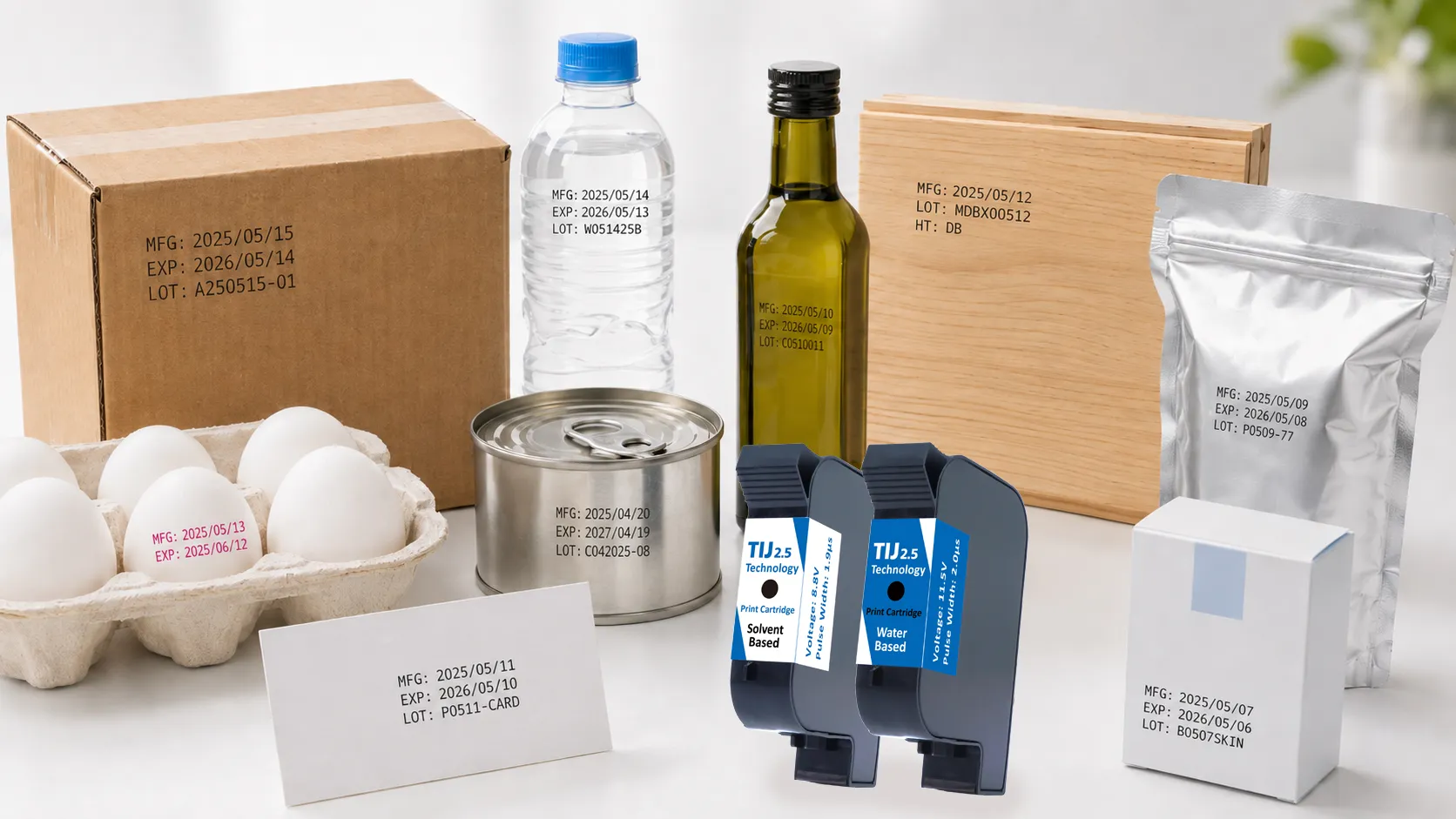
Substrate is the first filter in any selection process.
For absorbent materials like cardboard, paper, and wood, water-based TIJ is usually the first thing worth evaluating. For eggshells and other food-related applications, beyond adhesion and drying speed, you'll also need to confirm the ink meets whatever food-contact or food-marking regulations apply to that product, region, and use case.
For non-absorbent materials — plastic, metal, glass, foil, and coated packaging — common options include solvent-based TIJ, CIJ, laser marking, and print-and-apply labeling.
There's no single "most economical" answer for these materials. You'll need to test on the actual substrate:
Ink adhesion
Surface dry time
Abrasion and scratch resistance
Water and condensation resistance
Alcohol and chemical resistance
Mark retention over time
2. How fast is your line?
TIJ can be used on both intermittent and continuous lines, but the actual achievable speed depends on a number of factors, including:
Horizontal resolution
Length of the printed content
Number of print lines
Font and graphic complexity
Ink dry time
Distance between the printhead and the product
Controller and encoder capability
Which means you can't just compare the top line speed listed on a spec sheet.
For high-speed, long-duration continuous small-character coding, CIJ is usually the first technology worth evaluating. But if the mark includes high-resolution barcodes, graphics, or a lot of variable data, TIJ may actually be the better fit.
The right way to compare is to test each candidate machine at your actual line speed, using the same print content, resolution, and quality requirements across the board.
3. Do you have dedicated maintenance staff?
Maintenance capacity directly affects both equipment uptime and real-world cost.
TIJ refreshes the printhead every time the cartridge is replaced, so compared with systems using a fixed printhead built into the equipment, printhead-related maintenance needs are typically lower. Day-to-day, you'll still need nozzle wiping, capping, downtime management, and restart checks.
CIJ, by contrast, requires managing ink, makeup fluid, and the fluid system, and generally has more maintenance items. Some newer CIJ equipment now includes automatic cleaning, sealed consumable cartridges, or modular service designs that reduce manual maintenance burden — but scheduled service, consumable replacement, and service contract costs still need to be factored in.
If you don't have dedicated maintenance staff on-site, equipment architecture, operational complexity, and time-to-recovery after a fault may matter more than the sticker price of the consumables.
4. Does the mark need to be permanent, or just clearly readable?
If you need a mark that's highly abrasion- and solvent-resistant, or difficult to remove, laser marking is usually the first option worth evaluating.
Laser isn't suitable for every material, though. Before adopting it, confirm:
Whether the substrate produces enough contrast
Whether the laser process could damage the packaging or product
Whether it generates fumes, particulates, or odor
Whether fume extraction and filtration equipment is required
Whether it meets laser safety requirements
It's also worth testing laser against durable inkjet inks and resin-based thermal transfer ribbons on your actual substrate.
If the mark just needs to stay clearly readable through production, distribution, and shelf life, TIJ, CIJ, TTO, or labeling are all worth evaluating first.
"It's just a date code or batch number" doesn't automatically mean low durability requirements. Products can encounter condensation, freezing temperatures, alcohol, abrasion, oil, or chemicals during distribution — so adhesion, water resistance, abrasion resistance, and chemical resistance still need to be tested against the actual environment.
Calculating True Per-Unit Cost of Coding Technologies
The most common mistake in procurement is comparing only the equipment quote or a single consumable's unit price.
A complete total cost of ownership (TCO) should include, at minimum:
Equipment purchase and installation
Ink, makeup fluid, ribbon, and labels
Cleaning fluid, filters, and other maintenance consumables
Maintenance and operator labor
Scheduled service and service contracts
Downtime and restart time
Scrap and rework from coding defects
Power, exhaust, and compressed-air requirements
Spare-parts inventory and consumable shelf-life loss
Cartridge unit price and per-milliliter bulk ink price aren't directly comparable.
Cartridge-based systems may have lower maintenance and downtime costs; bulk ink supply systems may lower per-unit ink cost at high, steady production volumes. The actual outcome depends on volume, print coverage, start/stop frequency, on-site labor, and equipment utilization.
The more reliable approach is to build a TCO model using your own line data, then compare options — rather than comparing a single equipment or consumable quote in isolation.
In our experience at Uniplus, the same cartridge can deliver very different real-world yields depending on print coverage and how often the line starts and stops, which is why a catalog "prints per cartridge" figure rarely transfers cleanly to your line. A more practical approach: log one or two weeks of actual usage, downtime events, and reprints, then convert everything to a cost per thousand marks. That number frequently overturns the conclusion you'd reach from unit price alone.
Common Misconception: Marking Technologies Aren't Mutually Exclusive
Choosing a marking technology isn't necessarily an either/or decision.
Within a single facility, it's common — and reasonable — for different lines to use different technologies. For example:
Water-based TIJ for outer cardboard cartons
Solvent-based TIJ or CIJ for plastic inner packaging
TTO for flexible packaging film
Laser for high-durability metal parts
Print-and-apply labeling for packaging that needs extensive regulatory information
The real unit of decision-making should be "this specific substrate, this specific print content, this specific line condition" — not a mandate that the entire facility standardize on one single technology.
When a plant asks to standardize on one technology across every line, the motivation is usually sound: simpler spare-parts management and less operator retraining. But in our experience at Uniplus, the cost tends to show up elsewhere — a couple of lines end up running consumables that were never a good match for their substrate, and it comes back as adhesion complaints or scrap. The workable compromise is usually to standardize the consumable specification and the supply source so spares stay interchangeable, rather than forcing every line onto the same marking technology.
Separately, Regulation (EU) 2025/40 — the EU Packaging and Packaging Waste Regulation (PPWR) — entered into force on 11 February 2025 and generally applies from 12 August 2026, with some requirements subject to transition periods or staggered implementation.
PPWR primarily establishes requirements around packaging manufacturing, material composition, recyclability, and reusability, along with related labeling. This packaging-environmental information is not the same category of marking as a product batch number, serial number, expiry date, or process traceability code.
Whether primary packaging, outer cartons, and transport packaging each need separate coding still depends on individual product regulations, customer specifications, and supply-chain management needs — it shouldn't be read as a single regulation mandating identical coding across every packaging level.
Comparison of Different Coding Technologies
It is difficult to fully break down the differences between each set of technologies in a single article. To address different selection scenarios, we have compiled the following topics:
Technical Differences Between TIJ and Piezoelectric DOD
TIJ is itself a type of Drop-on-Demand (DOD) technology that uses thermal bubbles to eject ink droplets. Other common architectures include piezoelectric DOD and valve-based inkjet. TIJ vs Piezoelectric DOD Industrial Inkjet: Key Differences and How to Choose will compare the differences among these various drive mechanisms in terms of ink compatibility, printhead durability, and application scenarios.
Not Sure Which TIJ Product Fits? Bring Us Your Line Conditions
Uniplus was founded in 2002, building up experience in printhead, chip, and cartridge manufacturing before later expanding into the TIJ 2.5 industrial inkjet market.
Our current product line includes:
Solvent-based industrial ink
Water-based dye ink
Water-based pigment ink
Half-inch industrial cartridges
One-inch industrial cartridges
Every product undergoes quality testing before it leaves the factory. We can also help with equipment compatibility confirmation, substrate-and-ink matching, and pre-production evaluation.
Rather than comparing spec sheets on your own, it's usually faster to just tell us:
The substrate you're printing on
Your line speed
The print content and dimensions
The operating environment
Water, abrasion, or chemical resistance requirements
Daily volume and start/stop frequency
The more specific the conditions, the faster we can rule out the technologies and consumables that won't work.
Share this article to your friends
TIJ vs Other Coding Technologies: How Do You Choose the Right Fit for Your Production Line?
Highlights
Choosing the wrong marking technology rarely shows up only in the equipment invoice. The real cost usually follows later, in consumables, maintenance labor, scrapped product, and line downtime.
TIJ (Thermal Inkjet) is one of the most common industrial coding technologies, but it isn't the right fit for every line. Selection shouldn't come down to resolution or unit price alone — substrate, line speed, mark durability, maintenance capacity, and total cost of ownership all need to be weighed together.
This article compares TIJ, CIJ, laser marking, thermal transfer overprinting (TTO), and print-and-apply labeling within a single evaluation framework, to help you judge which technology actually fits your current line conditions.
If you're not yet familiar with how TIJ works, start with What Is TIJ Printing? A Beginner's Guide to the Technology, then come back to work through the selection questions below.
What Is TIJ?
TIJ is a non-contact printing technology that uses a thin-film resistor to flash-heat ink, forming a bubble that ejects a droplet through the nozzle.
In a typical cartridge-based TIJ 2.5 system, the printhead and ink are integrated into a single replaceable cartridge. Because the printhead is replaced along with the cartridge, this approach generally reduces printhead maintenance compared with systems that use a fixed printhead built into the equipment.
It's worth noting that not every TIJ system uses an all-in-one cartridge design. Some industrial TIJ equipment uses remote ink supply, bulk ink systems, or a separate printhead architecture — and the maintenance model and consumable cost structure for these setups differ accordingly.
This is also why the comparison table below is specifically labeled "TIJ 2.5" —— in a cartridge system, the printhead is treated as part of the consumable. It gets refreshed every time the cartridge is replaced, and that single design choice shapes both the maintenance pattern and the cost structure.
None of this means TIJ is maintenance-free. In practice you'll still need nozzle wiping, capping, extended-downtime management, and start-up checks. That's also an important difference to keep in mind when comparing the real cost of TIJ against CIJ or laser marking.
Five Production-Line Marking Methods, Side by Side
The table below summarizes the core characteristics of five common marking methods. Actual performance still depends on the specific equipment model, consumables, substrate properties, line speed, and operating environment.
Note: the content above reflects common characteristics for each technology; it doesn't represent every model, and shouldn't be read as a market pricing or total-cost-of-ownership comparison. Before committing to any option, confirm with the supplier's spec sheet, sample testing, and validation on your actual line.
Where TIJ Fits Technically
The typical strength of industrial TIJ is high-resolution output. Some systems reach up to 600 dpi, which suits small text, graphics, and dense 1D and 2D barcodes.
High resolution alone doesn't guarantee a compliant barcode. Whether a barcode meets GS1 General Specifications depends on a combination of factors:
So dpi alone can't tell you whether a barcode will actually meet real-world scanning and verification requirements.
dpi is almost always the first question customers ask. But in our experience at Uniplus, when scanning actually fails on a line, the cause is rarely resolution — it's usually ink spread on an absorbent substrate, a barcode scaled down too far to fit the artwork, or a quiet zone squeezed by the packaging design. A more useful step before locking in a machine model: print samples on your real substrate at the real code size and run them through a verifier. That surfaces problems far earlier than comparing spec sheets does.
On print height: a common half-inch TIJ cartridge delivers a single-pass print height of roughly 12.7 mm. For larger character heights, options include a one-inch printhead, a wider print module, or stitching multiple printheads together.
The minimum readable character height, meanwhile, depends on font design, resolution, ink spread, substrate surface, and the actual scanning distance — there's no fixed floor that applies across every device and substrate.
If you want to understand TIJ's characteristics at a structural level, see What's Inside a TIJ Cartridge? Printhead, Chip, and Ink Explained.
How to Choose the Right Labeling Printing Methods? 4 Key Questions
You don't need to compare every spec sheet up front. Answering these four questions first will usually narrow the field to one or two technologies.
1. What substrate are you printing on?

Substrate is the first filter in any selection process.
For absorbent materials like cardboard, paper, and wood, water-based TIJ is usually the first thing worth evaluating. For eggshells and other food-related applications, beyond adhesion and drying speed, you'll also need to confirm the ink meets whatever food-contact or food-marking regulations apply to that product, region, and use case.
For non-absorbent materials — plastic, metal, glass, foil, and coated packaging — common options include solvent-based TIJ, CIJ, laser marking, and print-and-apply labeling.
There's no single "most economical" answer for these materials. You'll need to test on the actual substrate:
2. How fast is your line?
TIJ can be used on both intermittent and continuous lines, but the actual achievable speed depends on a number of factors, including:
Which means you can't just compare the top line speed listed on a spec sheet.
For high-speed, long-duration continuous small-character coding, CIJ is usually the first technology worth evaluating. But if the mark includes high-resolution barcodes, graphics, or a lot of variable data, TIJ may actually be the better fit.
The right way to compare is to test each candidate machine at your actual line speed, using the same print content, resolution, and quality requirements across the board.
3. Do you have dedicated maintenance staff?
Maintenance capacity directly affects both equipment uptime and real-world cost.
TIJ refreshes the printhead every time the cartridge is replaced, so compared with systems using a fixed printhead built into the equipment, printhead-related maintenance needs are typically lower. Day-to-day, you'll still need nozzle wiping, capping, downtime management, and restart checks.
CIJ, by contrast, requires managing ink, makeup fluid, and the fluid system, and generally has more maintenance items. Some newer CIJ equipment now includes automatic cleaning, sealed consumable cartridges, or modular service designs that reduce manual maintenance burden — but scheduled service, consumable replacement, and service contract costs still need to be factored in.
If you don't have dedicated maintenance staff on-site, equipment architecture, operational complexity, and time-to-recovery after a fault may matter more than the sticker price of the consumables.
4. Does the mark need to be permanent, or just clearly readable?
If you need a mark that's highly abrasion- and solvent-resistant, or difficult to remove, laser marking is usually the first option worth evaluating.
Laser isn't suitable for every material, though. Before adopting it, confirm:
It's also worth testing laser against durable inkjet inks and resin-based thermal transfer ribbons on your actual substrate.
If the mark just needs to stay clearly readable through production, distribution, and shelf life, TIJ, CIJ, TTO, or labeling are all worth evaluating first.
"It's just a date code or batch number" doesn't automatically mean low durability requirements. Products can encounter condensation, freezing temperatures, alcohol, abrasion, oil, or chemicals during distribution — so adhesion, water resistance, abrasion resistance, and chemical resistance still need to be tested against the actual environment.
Calculating True Per-Unit Cost of Coding Technologies
The most common mistake in procurement is comparing only the equipment quote or a single consumable's unit price.
A complete total cost of ownership (TCO) should include, at minimum:
Cartridge unit price and per-milliliter bulk ink price aren't directly comparable.
Cartridge-based systems may have lower maintenance and downtime costs; bulk ink supply systems may lower per-unit ink cost at high, steady production volumes. The actual outcome depends on volume, print coverage, start/stop frequency, on-site labor, and equipment utilization.
The more reliable approach is to build a TCO model using your own line data, then compare options — rather than comparing a single equipment or consumable quote in isolation.
In our experience at Uniplus, the same cartridge can deliver very different real-world yields depending on print coverage and how often the line starts and stops, which is why a catalog "prints per cartridge" figure rarely transfers cleanly to your line. A more practical approach: log one or two weeks of actual usage, downtime events, and reprints, then convert everything to a cost per thousand marks. That number frequently overturns the conclusion you'd reach from unit price alone.
Common Misconception: Marking Technologies Aren't Mutually Exclusive
Choosing a marking technology isn't necessarily an either/or decision.
Within a single facility, it's common — and reasonable — for different lines to use different technologies. For example:
The real unit of decision-making should be "this specific substrate, this specific print content, this specific line condition" — not a mandate that the entire facility standardize on one single technology.
When a plant asks to standardize on one technology across every line, the motivation is usually sound: simpler spare-parts management and less operator retraining. But in our experience at Uniplus, the cost tends to show up elsewhere — a couple of lines end up running consumables that were never a good match for their substrate, and it comes back as adhesion complaints or scrap. The workable compromise is usually to standardize the consumable specification and the supply source so spares stay interchangeable, rather than forcing every line onto the same marking technology.
Separately, Regulation (EU) 2025/40 — the EU Packaging and Packaging Waste Regulation (PPWR) — entered into force on 11 February 2025 and generally applies from 12 August 2026, with some requirements subject to transition periods or staggered implementation.
PPWR primarily establishes requirements around packaging manufacturing, material composition, recyclability, and reusability, along with related labeling. This packaging-environmental information is not the same category of marking as a product batch number, serial number, expiry date, or process traceability code.
Whether primary packaging, outer cartons, and transport packaging each need separate coding still depends on individual product regulations, customer specifications, and supply-chain management needs — it shouldn't be read as a single regulation mandating identical coding across every packaging level.
Comparison of Different Coding Technologies
It is difficult to fully break down the differences between each set of technologies in a single article. To address different selection scenarios, we have compiled the following topics:
Technical Differences Between TIJ and Piezoelectric DOD
TIJ is itself a type of Drop-on-Demand (DOD) technology that uses thermal bubbles to eject ink droplets. Other common architectures include piezoelectric DOD and valve-based inkjet. TIJ vs Piezoelectric DOD Industrial Inkjet: Key Differences and How to Choose will compare the differences among these various drive mechanisms in terms of ink compatibility, printhead durability, and application scenarios.
If you'd like to dig deeper into real-world line applications, see How Coding Equipment Improves Production Line Value: Five Application Scenarios, which covers common adoption patterns across industries.
To revisit the fundamentals, see What Is TIJ Printing? A Beginner's Guide to the Technology.
Not Sure Which TIJ Product Fits? Bring Us Your Line Conditions
Uniplus was founded in 2002, building up experience in printhead, chip, and cartridge manufacturing before later expanding into the TIJ 2.5 industrial inkjet market.
Our current product line includes:
Every product undergoes quality testing before it leaves the factory. We can also help with equipment compatibility confirmation, substrate-and-ink matching, and pre-production evaluation.
Rather than comparing spec sheets on your own, it's usually faster to just tell us:
The more specific the conditions, the faster we can rule out the technologies and consumables that won't work.
To see product specs directly, visit the TIJ 2.5 industrial inkjet cartridge page.
▶ Contact us to discuss your line's marking and equipment selection