Search by Keywords | Ink Cartridge Model

We use cookies to personalize content and ads, provide social media features, and analyze our traffic. By clicking Privacy Policy.
Please contact us for more information
We use cookies to personalize content and ads, provide social media features, and analyze our traffic. By clicking Privacy Policy.
Please contact us for more information
Share this article to your friends
TIJ vs Piezoelectric DOD Industrial Inkjet: Key Technology Differences and How to Choose
Highlights
When you set out to add an industrial inkjet system to your line, the first hurdle often isn't budget—it's not knowing what actually separates "TIJ" from "DOD." Here's a point many people miss: TIJ is itself a type of DOD, so putting the two side by side is a category error. What you should really be comparing is thermal (TIJ) versus piezoelectric—the two common DOD actuation mechanisms. If you want the fundamentals first, start with our article "What Is TIJ Thermal Inkjet Printing? A Ground-Up Introduction".
This comparison is written mainly from the perspective of industrial marking, variable-data coding on packaging, and common production-line integration. If your application involves commercial digital printing, textiles, ceramics, or functional-material deposition, it still needs to be evaluated separately against the specific printhead and full system architecture.
What is DOD?
DOD (Drop-on-Demand) refers to a printing method where the printhead ejects droplets only at the positions that need imaging. Its counterpart is continuous inkjet (CIJ): CIJ generates a continuous stream of droplets and uses charging and an electric field to steer selected droplets onto the product surface, while unused droplets are returned to the ink system via a gutter. In today's mainstream industrial inkjet applications, the common DOD actuation mechanisms are thermal and piezoelectric.
Thermal TIJ: Using a Localized Vapor Bubble to Push the Droplet
TIJ (Thermal Inkjet) works by momentarily heating a micro heating resistor inside the printhead, so that a very thin layer of ink near the resistor surface rapidly forms a vapor bubble; the expanding bubble's pressure pushes a droplet out of the nozzle. It's worth noting that only the thin layer at the resistor surface is vaporized—not the entire ink chamber. This is also why TIJ is often called "thermal bubble" printing.
Piezoelectric DOD: Using Crystal Deformation to Squeeze Out the Droplet
A piezoelectric printhead uses a piezoelectric actuator coupled to the ink-chamber structure. When voltage is applied, the actuator deforms, changing the chamber volume and creating a pressure wave that pushes a droplet out of the nozzle. It doesn't rely on heat, but on mechanical deformation. Piezoelectric printheads are commonly found in fixed ink-supply systems and suit applications with more demanding requirements for ink type and droplet control.
How Do the Common System Architectures of TIJ and Piezoelectric Differ?
First, an important clarification: what follows describes the "system architectures common in the industrial coding market," not the underlying technology itself. TIJ isn't always a disposable cartridge, and piezoelectric isn't always a fixed printhead—both mechanisms exist in other architectures.
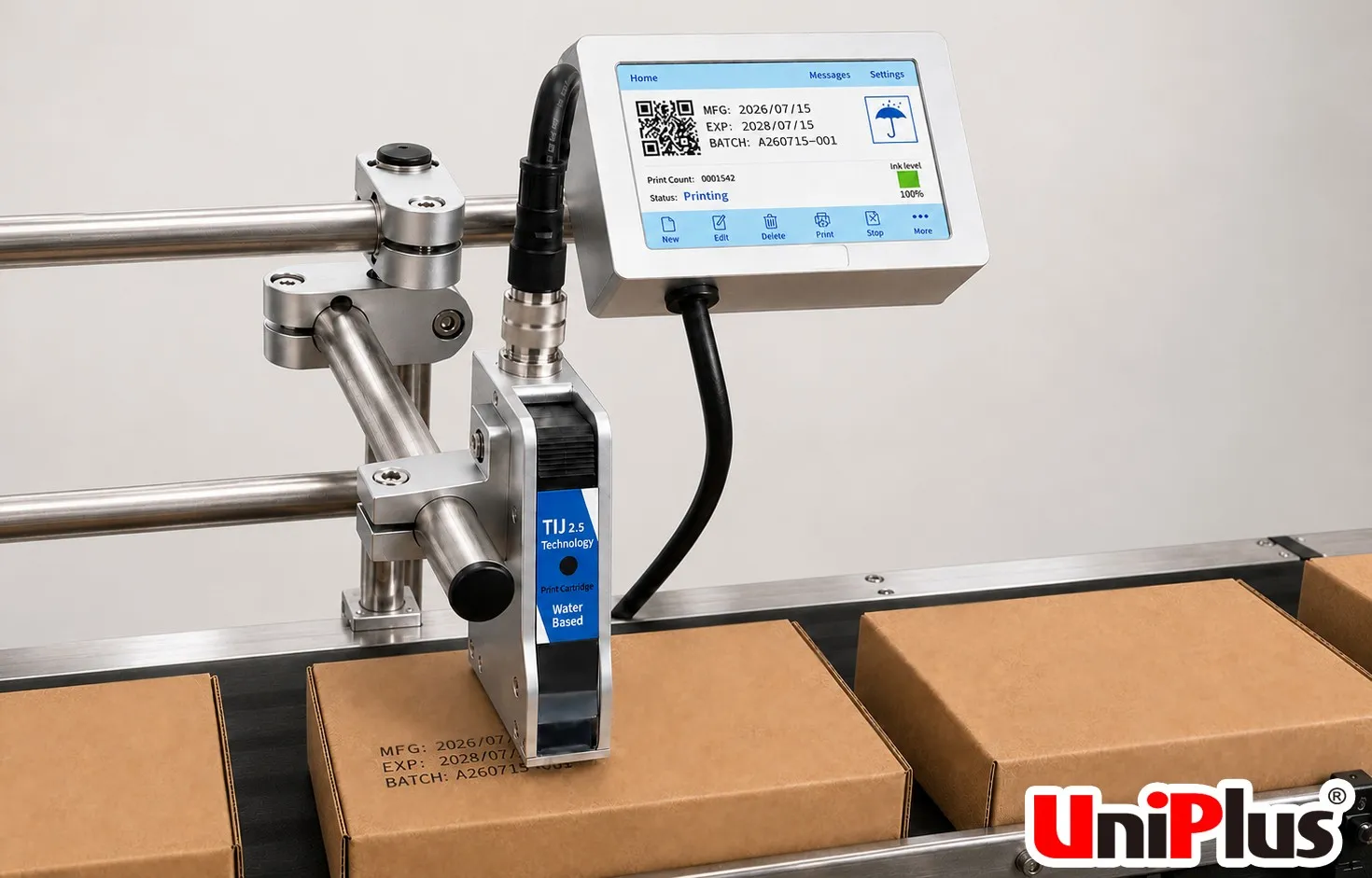
In industrial marking systems based on HP 45-class cartridges, TIJ commonly uses an all-in-one cartridge that integrates the printhead and ink; when the ink runs out or the nozzles degrade, you simply swap the whole cartridge. But that's just the mainstream approach—TIJ printheads can also be paired with separate ink tanks or other supply structures.
In industrial settings, piezoelectric more commonly uses a fixed printhead with a separate ink-supply system that may include recirculation, negative-pressure control, filtration, degassing, capping, and head cleaning. As a result it has more components and higher integration and fluid-control requirements. That said, piezoelectric also comes in modular or replaceable printhead forms, so this is a "usually," not an absolute distinction.
Key Differences Between TIJ and Piezoelectric DOD
Both are drop-on-demand, but they differ noticeably in actuation principle, ink compatibility, and maintenance. Here are the dimensions that matter most to purchasing:
TIJ in Practice: Fast Cartridge Swaps, Low Integration Barrier
In systems that utilize all-in-one cartridges, TIJ provides a practical benefit: if a nozzle fails or the ink depletes, you can easily replace the entire cartridge, which generally shortens troubleshooting and printhead replacement times.
However, Uniplus's experience indicates that maintenance remains essential. Depending on factors such as ink volatility, ambient dust, and downtime, you may still need to wipe nozzles, cap or humidify, or execute a nozzle recovery routine. The primary advantage lies in lessening the long-term burden of maintaining a fixed printhead, rather than completely eliminating maintenance.
Piezoelectric in Practice: Greater Flexibility in Fluids and Droplet Control
Because piezoelectric doesn't use a thermal bubble to actuate, some printheads can—through wetted materials, operating temperature, supply design, and drive waveforms—support a broader range of fluid types, including UV-curable inks and some functional fluids. Some piezoelectric printheads can also achieve multi-level grayscale and variable-droplet control, suiting applications that need ink-volume adjustment, large-area coverage, or functional-material deposition.
By contrast, a fixed piezoelectric system generally needs a more complete set of recirculation, negative-pressure, filtration, cleaning, and printhead-protection mechanisms, which can raise component count and integration requirements. Whether the initial investment exceeds TIJ still depends on print width, number of printheads, line speed, supply design, and auto-maintenance needs; the actual fluid viscosity range and maintenance frequency must also be confirmed by printhead model.
TIJ or Piezoelectric DOD? Deciding from Your Line's Conditions
There is no universally "better" technology. The right choice depends on your substrate, application, and production requirements.
When to Choose TIJ
When to Choose Piezoelectric DOD
Keep in Mind
Large-character coding is not exclusive to piezoelectric. Depending on character height, resolution, and ink volume requirements, valve-jet DOD, CIJ, or stitched multi-head TIJ systems may also be suitable. In Uniplus's experience, the most common purchasing mistake is assuming a given requirement can only be met by one technology, which needlessly narrows the options; it's better to first pin down character height, resolution, substrate, and ink-volume needs, then let your supplier help match the viable technology combinations.
Before Adopting TIJ, How Do You Calculate Cost?
Cost is the easiest thing to get wrong, and the key is not to mistake "cost occurring differently" for "cost disappearing." An all-in-one-cartridge TIJ doesn't require long-term maintenance of one fixed printhead, but part of the printhead lifecycle cost is carried into consumables with each cartridge change. A fixed piezoelectric system, in turn, can incur printhead, cleaning-fluid, purge, filtration, and downtime-maintenance costs—and the two must be compared at the same output volume and print conditions.
When comparing cost, don't look only at ink unit price or at a "prints per liter" figure with no stated test conditions. If you use per-liter output as a metric, you must fix the print content, resolution, coverage, and line conditions, and account for nozzle-recovery, cleaning, and purge losses. In practice you can also convert it into cost per 1,000 marks or total cost of ownership per month.
Worth remembering: ink-and-substrate compatibility is one of the key factors affecting adhesion and durability, and must be evaluated together with printhead specs, throw distance, line speed, and working environment. If this step isn't tested during procurement, it can lead to adhesion, dry-time, or rub-resistance results that fall short of expectations after go-live. Uniplus offers ink-and-substrate compatibility evaluation to help confirm, before adoption, whether a formulation suits your material and working environment.
Still Not Sure Which Printing Technology Fits Your Line?
Choose the wrong printing technology and you often only find out after go-live—poor ink adhesion, or a cost structure that doesn't match expectations. Rather than guessing, let us help you evaluate substrate, print content, and ink formulation together. To see the full picture across printing technologies, you can also return to our pillar article TIJ vs Other Coding Technologies: How Do You Choose the Right Fit for Your Production Line?.
→ Contact us for production-line printing advice